What to Expect During SAINT Therapy vs. Standard TMS Treatment
Madison Lawrence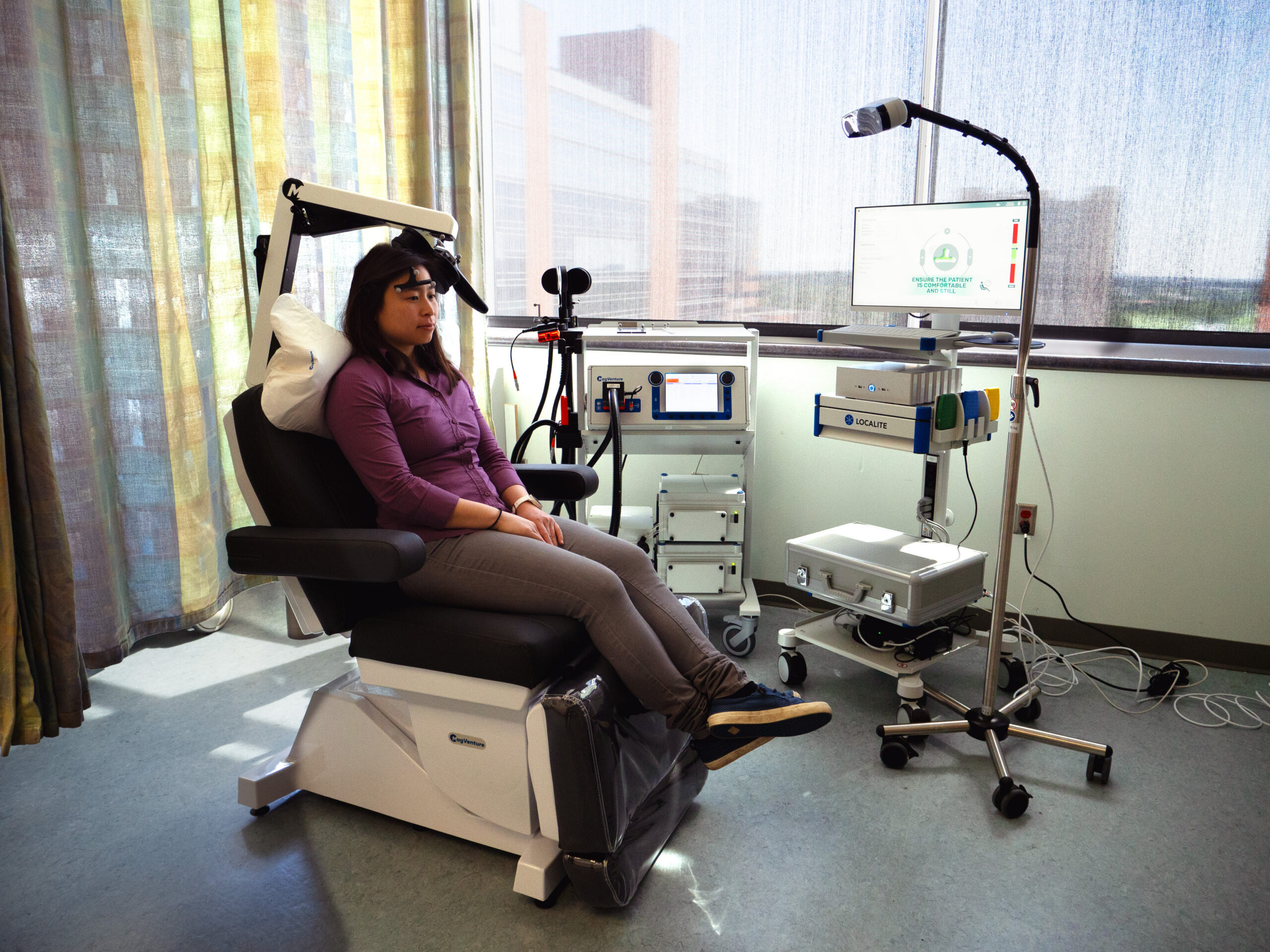
Key Takeaways
- Rapid Remission: Patients reach remission in an average of 2.6 days¹, significantly faster than the weeks or months required by conventional treatments.
- Precision Mapping: SAINT uses individual fMRI scans and proprietary algorithms to target the specific circuits responsible for your mood regulation.
- Proven Efficacy: Clinical studies show a 79% remission rate for those who have not seen improvement from prior antidepressant medications.²
- Condensed Timeline: The entire treatment course is completed in just five days, minimizing the logistical burden of standard TMS treatments.
Living with treatment-resistant depression (TRD) often feels like navigating a world without a map. Seeking treatments can be a constant cycle of trial and error, where the weight of one’s symptoms is compounded by frustration with medicines that don’t quite reach the target.
For years, transcranial magnetic stimulation (TMS) treatment has provided a viable alternative for people living with depression whose condition has not responded to antidepressants. Rather than operating chemically through the bloodstream, TMS works electrically and biologically by targeting the brain’s circuitry directly.
Today, a new evolution in neuroscience has arrived. SAINT® Depression Therapy represents a breakthrough in precision brain health, delivering rapid and targeted relief by tailoring stimulation to your unique biology.
With an average of only 2.6 days to remission¹ and a 79% remission rate in clinical trials², SAINT is not only an improvement on traditional TMS processes—it is a fundamental reimagining of how to restore the brain’s natural rhythm.
Understanding TMS Treatment
To understand the SAINT difference, one must first understand standard TMS treatment. At its core, TMS is a non-invasive procedure that uses gentle magnetic pulses to stimulate nerve cells in the regions of the brain responsible for mood control. It is a biological intervention, not a chemical one, making it an excellent option for those seeking a non-drug path to wellness.
Standard TMS treatments use a generalized anatomical landmark to guide stimulation and typically require 30 or more daily sessions over six to nine weeks. While the treatment can be effective, the process presents a significant logistical burden. Committing to daily appointments for two months is a barrier for many working professionals and caregivers, and the standardized approach does not account for each patient’s unique anatomy.
At Magnus Medical, we understand that brain health is not one-size-fits-all. That’s why SAINT Depression Therapy evolves this TMS treatment process through personalization. Using fMRI-guided targeting, SAINT identifies the exact doorway into your brain’s mood-regulating circuit, delivering aiTBS (accelerated intermittent Theta Burst Stimulation) exactly where your brain needs it most. By focusing on the precise parts of your brain that require stimulation, SAINT Therapy removes guesswork and dramatically speeds up the timeline to remission.
| Feature | SAINT Depression Therapy | Standard TMS |
| Technology | fMRI-guided – uses proprietary algorithms to map your unique brain connectivity. | Scalp-based – uses generalized anatomical landmarks for coil placement. |
| Treatment Length | 5 consecutive days | 6 to 9 weeks |
| Daily Intensity | 10 sessions per day (10-minute active stimulation, 50-minute rest). | 1 session per day (typically 20–40 minutes). |
| Average Time to Remission | 2.6 days¹ | ~6 weeks³ |
| Clinical Remission Rate | 79% in clinical trials² | ~30-40% in real-world clinical settings³ |
| Time Burden | Low – a single week of intensive care. | High – requires daily appointments for up to two months. |
What to Expect During SAINT Therapy
Before beginning treatment, you want to ensure your brain is in the best position to respond to the stimulation. Providers generally recommend prioritizing sleep and avoiding non-prescribed substances that can alter brain activity during your treatment week (although most patients continue their conventional depression treatments alongside SAINT).
If you have questions regarding how to prepare for your SAINT Therapy treatment, consult your doctor or SAINT provider for specific instructions tailored to your unique health history.
Step 1: Precision Brain Mapping
The treatment process begins with an fMRI scan. Unlike standard TMS, which relies on scalp-based measurements, SAINT uses structural and functional MRI to visualize your brain’s unique wiring.
Our proprietary algorithm analyzes this scan to identify the specific area within the dorsolateral prefrontal cortex (DLPFC) most strongly connected to deeper brain structures involved in depression. This diagnostic step is entirely non-invasive and ensures that your treatment is personalized to your specific neural architecture before the first session even begins.
Step 2: The 5-Day Treatment Schedule
While standard TMS is an elongated process, SAINT is an intensive, five-day cycle. This is designed to induce rapid neuroplasticity, helping the brain “relearn” healthy communication patterns quickly.
The schedule consists of:
- 10 Sessions Per Day: Each session involves 10 minutes of active intermittent theta-burst stimulation (aiTBS).
- Rest and Recovery: A 50-minute break follows each session. During this time, the clinical setting is designed for your comfort. You can read, listen to music, nap, or speak with a support person.
- Expert Support: Throughout the five days, you will be guided by a verified SAINT provider to ensure your environment is as comfortable as possible.
What the Treatment Feels Like
During the treatment, you remain fully awake and alert. You will hear a clicking sound and feel a light tapping sensation on the scalp, similar to the peck of a woodpecker. Because SAINT is non-invasive, there is no need for anesthesia or sedation, and no recovery time is required between treatment days or after the five-day process is complete.
Some patients may experience mild, temporary side effects, such as site discomfort or a slight headache, which typically resolve quickly.
Step 3: Rapid Remission and Return to Daily Life
The goal of SAINT is remission rather than just symptom relief. While conventional medications are often prone to a chronic cycle of relapse, the objective here is to restore the brain’s functional connectivity.
Many patients report a noticeable shift in their mood or sense of clarity by the second or third day. This rapid shift is the hallmark of SAINT Therapy. Once remission is achieved, your care team will work with you to develop a personalized follow-up plan, monitor progress, and help you integrate your newfound relief into daily wellness activities and lifestyle adjustments.
The ultimate goal is to support your return to daily life. Whether that means getting back to work, reconnecting with family, or pursuing hobbies that depression once made impossible, SAINT Therapy is designed to give you the biological foundation to move forward.
Is SAINT Therapy Right for You?
SAINT Depression Therapy is specifically FDA-cleared for adults (aged 22+) who have not seen satisfactory improvement for Major Depressive Disorder from prior antidepressant medications. If the logistical burden of a six-week standard TMS treatment feels unmanageable, or if your life requires a more immediate return to form, SAINT Therapy offers a bridge to rapid recovery.
Depression is a biological condition rooted in the circuitry of the brain, but it does not have to be your permanent reality. The journey to rapid remission begins with a single conversation. Whether you are a person living with depression or a caregiver looking for a breakthrough, a specialized SAINT provider can help you determine if this personalized treatment is the right fit for your brain health.
SAINT Depression Therapy FAQs
What makes SAINT Depression Therapy different from conventional TMS?
Conventional Transcranial Magnetic Stimulation (TMS) typically requires daily sessions over six to nine weeks and often uses a one-size-fits-all approach for targeting. In contrast, SAINT Depression Therapy is an accelerated treatment completed in just five days and uses personalized fMRI brain imaging to identify the optimal anatomical target unique to each patient’s brain.
How quickly can I expect to see improvements in my depression?
SAINT Therapy is designed for rapid remission. In clinical trials, participants reached remission in an average of 2.6 days.1 Our mandatory clinical claim states that 79% of patients achieve remission within the five-day treatment duration.2
What is the daily schedule like during the five days of treatment?
The treatment involves 10 sessions per day for five consecutive days. Each session consists of 10 minutes of active stimulation followed by a 50-minute rest period, allowing patients to relax, read, or do light work between treatments.
Does the treatment require any surgery or anesthesia?
No. SAINT Therapy is a non-invasive, non-drug therapy. It does not require anesthesia or sedation, and patients are typically able to drive themselves to and from their appointments.
Are there any side effects associated with SAINT Therapy?
The treatment is generally well-tolerated. The most common side effects reported in clinical trials are mild-to-moderate headaches or temporary discomfort at the stimulation site.
How does SAINT Therapy’s precision targeting work?
SAINT Depression Therapy uses a proprietary algorithm to analyze a patient’s structural and functional MRI (fMRI). This creates a unique map of the individual’s brain connectivity, allowing providers to deliver stimulation to the precise area most involved in their depression.
Do I need to stop my other medication to receive SAINT treatment?
In general, you do not need to stop your current medications to receive SAINT Depression Therapy. Most people living with depression continue their conventional treatments throughout the five-day protocol, as SAINT is a non-systemic intervention that does not carry the same risk of drug-to-drug interactions as chemical treatments. However, you should never discontinue or alter any prescribed medication without professional guidance. Your verified SAINT provider will perform a comprehensive review of your medical history to ensure your treatment plan is optimized for your specific needs.
1 Cole, E. J., et al. (2020). Stanford Accelerated Intelligent Neuromodulation Therapy for Treatment-Resistant Depression. The American journal of psychiatry, 177(8), 716–726. https://doi.org/10.1176/appi.ajp.2019.19070720
2 Cole, E. J., et al. (2022). Stanford Neuromodulation Therapy (SNT): A Double-Blind Randomized Controlled Trial. The American journal of Psychiatry, 179(2), 132–141. https://doi.org/10.1176/appi.ajp.2021.20101429
3 George, M. S., Taylor, J. J., & Short, E. B. (2013). The expanding evidence base for rTMS treatment of depression. Current opinion in psychiatry, 26(1), 13–18. https://doi.org/10.1097/YCO.0b013e32835ab46d

Explore more
Read new insights, patient stories, and updates about personalized neuromodulation treatment for major depressive disorder.