
Oct 8, 2026
How Adult Depression Became More Visible in America
Madison
Two people experiencing similar symptoms may appear very differently in the data, depending on how their experiences are measured and whether they seek care. One may meet diagnostic criteria during a structured interview, another may report symptoms in a survey, and another may report a diagnosis received from a healthcare professional. As public awareness, screening practices, access to care, and the language around mental health have changed, depression has become more visible in the United States.
That visibility does not translate into one simple upward trend. Each statistic captures a different part of the story. Magnus Medical created this resource to show how depression diagnosis and measurement have changed over time and what the available figures can tell us about mental health in America.
What Does It Mean for Depression to Become More Visible?
Depression becomes more visible when people have more ways to recognize it, talk about it, and seek help. A person who might once have gone without support may now encounter a screening tool, raise concerns with a healthcare professional, or report a previous diagnosis in a national survey.
Greater visibility can bring more people into conversations about mental health, but it can also change what appears in the data. More screening, greater willingness to report symptoms, and broader access to professional evaluation may all affect how often depression is identified.
Visibility therefore describes a change in recognition and reporting, not necessarily a single, steady increase in one consistent measurement.
How Depression Has Been Measured Over Time
National mental health data may track several different outcomes:
- Whether a person meets the diagnostic criteria for major depressive disorder
- Whether a person recently experienced symptoms associated with depression
- Whether a healthcare professional has ever diagnosed the person with depression
- Whether a person experienced a major depressive episode during the past year
- Whether a person experienced any mental illness during the past year
- Whether a person received mental health treatment
Each metric answers a different question and provides a different view of mental health.
The Early 2000s Baseline: Major Depressive Disorder
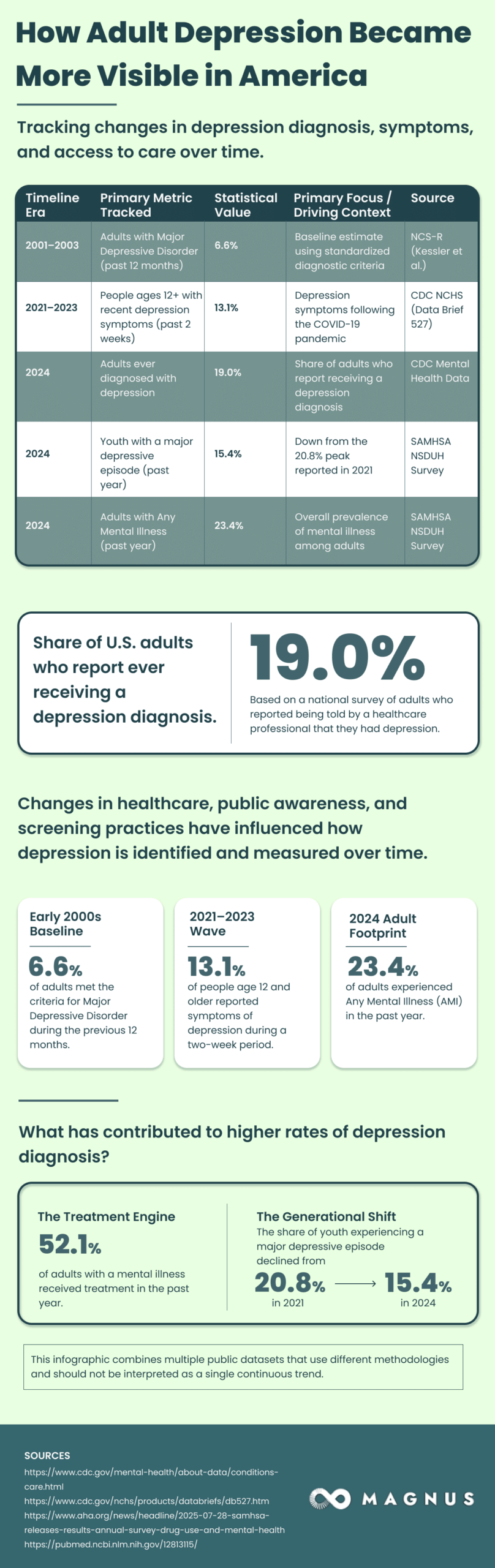
At the start of the 2000s, national researchers used structured interviews to estimate how many adults had experienced major depressive disorder during the previous year. From 2001 through 2003, the National Comorbidity Survey Replication found that 6.6% of U.S. adults met the criteria for the condition during the previous 12 months.
The estimate was based on structured interviews using standardized diagnostic criteria rather than on whether participants reported having previously received a diagnosis. This approach provides a useful reference point for understanding how major depressive disorder was measured at the time.
Recent Depression Symptoms From 2021 to 2023
Two decades later, national surveys were looking at depression through a different lens. CDC data collected from August 2021 through August 2023 found that 13.1% of people age 12 and older met the survey threshold for depression based on symptoms reported during the previous two weeks.
This figure reflects a recent moment in someone’s experience, not a formal diagnosis or a full medical history. A person could meet the symptom threshold without having been diagnosed, while someone with a previous diagnosis might not have reported symptoms during that particular period.
The timing also matters. Collected in the years following the major disruptions of the COVID-19 pandemic, the data offers a snapshot of symptoms reported during that period.
Nearly One in Five Adults Report a Depression Diagnosis
A separate 2024 measure looked beyond symptoms reported during a particular week or year. Nearly one in five U.S. adults, 19.0%, said a healthcare professional had told them at some point in their lives that they had depression.
That lifetime measure brings together many different experiences. Some adults may have been diagnosed recently, while others may have received the diagnosis years earlier. Some may still have symptoms, while others may have improved or be managing the condition with treatment.
The figure shows how common a reported depression diagnosis is across the adult population.
In 2024, 23.4% of Adults Experienced Any Mental Illness
The 2024 data also offers a wider view of mental health beyond depression alone. According to the National Survey on Drug Use and Health, 23.4% of U.S. adults experienced any mental illness during the previous year.
Any mental illness, often abbreviated as AMI, covers a broad range of mental, behavioral, and emotional disorders. Depression is included within that category, but it is only one of the conditions represented.
For that reason, the 23.4% figure should not be read as the percentage of adults with depression. Instead, it provides broader context for how common mental health conditions were among U.S. adults in 2024.
Why These Percentages Do Not Form a Single Trendline
Seen side by side, 6.6%, 13.1%, 19.0%, and 23.4% may look like steps in one steadily rising trend. But each number comes from a different kind of measurement and captures a different part of the mental health picture.
The surveys differ in the populations studied, the periods covered, the questions asked, and the definitions used. One measures major depressive disorder, another recent symptoms, another lifetime diagnoses, and another the broader category of any mental illness.
These figures are separate snapshots, not points on one continuous line. Reading them according to what each survey measured provides a more accurate view of mental health over time.
What Has Contributed to Greater Depression Visibility?
No single development explains why depression has become more visible. Changes in awareness, screening, stigma, and access to information and care may all influence how often it is identified and reported.
Greater Public Awareness
Information about depression now appears across healthcare, education, workplaces, news coverage, and online communities. Greater exposure to accurate information may help people recognize persistent symptoms and understand that they can warrant professional attention.
More Routine Screening
Depression screening has become more common in primary care and other healthcare settings. These tools cannot provide a diagnosis on their own, but they can bring symptoms to a provider’s attention and lead to a more complete evaluation.
As screening reaches more people, it may also identify concerns among those who would not otherwise have sought specialized mental health care.
Reduced Stigma Around Mental Health
Stigma has not disappeared, but attitudes toward mental health have shifted. Conversations about therapy, medication, anxiety, burnout, and depression are more visible in both public and private life.
That openness may make people more willing to describe their symptoms honestly, report a previous diagnosis on a survey, or ask a healthcare provider for support.
Broader Access to Information and Care
Mental health information is easier to find than it was in the early 2000s, and people now have more ways to seek support. Telehealth, digital resources, employee assistance programs, school-based services, and public campaigns have all expanded the available pathways to care.
Access is still uneven. Cost, insurance coverage, location, provider shortages, and cultural barriers can all make treatment difficult to obtain. Even so, having more ways to begin the process may increase the number of people who receive an evaluation or diagnosis.
More Than Half of Adults With Any Mental Illness Received Treatment
The treatment rate shows that greater recognition does not always translate into receiving care. In 2024, 52.1% of adults with any mental illness received mental health treatment during the previous year.
That also means nearly half did not receive treatment during the same period. The difference highlights the gap that can remain between experiencing a mental health condition and receiving care.
Treatment can take many forms, including counseling, medication, hospitalization, or other mental health services. The right approach depends on the condition, its severity, a person’s health history, and how they respond to care.
Youth Major Depressive Episode Rate Declined From 2021 to 2024
The youth data provides a useful contrast to the adult figures. Among adolescents ages 12–17, the percentage who experienced a major depressive episode during the previous year fell from 20.8% in 2021 to 15.4% in 2024.
Although the rate declined, the 2024 figure still represents a substantial share of adolescents. It should not be read as evidence that youth depression is no longer a serious concern.
Youth figures also need to remain separate from adult statistics. Age, family circumstances, school environments, social development, and access to support can all shape mental health and how symptoms are reported.
Following the rate over several years helps show whether the decline continues, levels off, or reverses.
Visibility Can Support Earlier Recognition
Greater visibility can support earlier recognition, but its value ultimately depends on whether people can connect with appropriate care. The data highlights the growing visibility of mental health conditions while also revealing gaps in treatment access.
For adults with major depressive disorder who have not improved sufficiently with antidepressant medication during their current episode, other treatment options may be worth discussing with a qualified healthcare professional. Magnus Medical developed SAINT Depression Therapy, an FDA-cleared, noninvasive neuromodulation treatment for eligible adults with major depressive disorder. The provider directory can help patients locate a verified SAINT provider and learn whether the treatment may be appropriate for them.
As mental health research and data collection continue to evolve, reading each statistic in context will remain essential to understanding depression and the gaps that remain in access to care.
Sources
https://www.cdc.gov/mental-health/about-data/conditions-care.html
https://www.cdc.gov/nchs/products/databriefs/db527.htm
Explore more
Read new insights, patient stories, and updates about personalized neuromodulation treatment for major depressive disorder.